 dug
dug 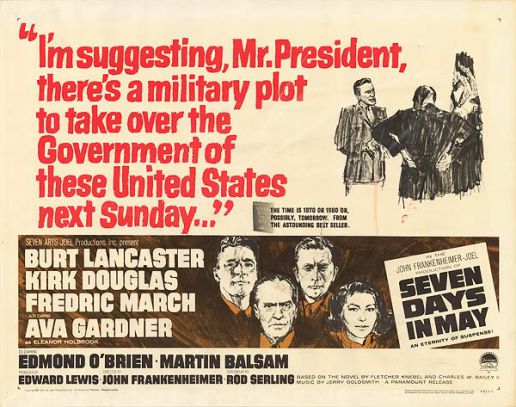
So re-watched Seven Days in May last night. With everything going on right now it’s a weird thing, it’s almost like it predicted 2025 better than we might have realised
The crisis that wasn’t supposed to happen
On December 6, 2025, the Trump administration released its National Security Strategy. The headline was stark: the Western Hemisphere—not China, not Russia—would be America’s top military priority. Within hours, President Trump announced that “land attacks are coming soon” in South America. The U.S. military’s largest aircraft carrier, the USS Gerald R. Ford, along with its carrier strike group, is now positioned off Venezuela’s coast.
This is more insidious because it works within the formal structure of civilian control while undermining its substance.
Over the past three months, the Trump administration has conducted at least 22 military strikes on small boats in the Caribbean and Pacific, killing more than 80 people. The official justification is drug trafficking. The actual motive, according to Venezuelan President Nicolás Maduro and Colombian President Gustavo Petro, is regime change. Multiple legal experts argue the strikes violate international law and Pentagon rules on shipwrecked persons. So far, if military leadership is resisting, they are not doing so publicly.
This is not the military coup depicted in John Frankenheimer’s 1964 political thriller “Seven Days in May.” But it is something the film warned about—something perhaps more dangerous.
The film that President Kennedy encouraged and assisted as a warning
“Seven Days in May” was made at the personal insistence (he didn’t ‘commission’ it as such, but deployed some serious soft-power to get it off the ground) of President John F. Kennedy, who had witnessed the dangers of military extremism first-hand. In 1961, the Pentagon had to relieve General Edwin Walker (who then submitted his resignation) for indoctrinating troops with John Birch Society literature. Kennedy feared that far-right military officers might one day attempt to seize power if they disagreed with presidential policy. He encouraged the film as a warning to the American people.
The film’s plot is straightforward: General James Mattoon Scott, the Chairman of the Joint Chiefs of Staff, believes the President’s nuclear disarmament treaty is a catastrophic mistake. Scott organises a military coup, disguised as a training exercise called ECOMCON. The coup is thwarted when Colonel Casey, Scott’s own aide, chooses duty to the Constitution over loyalty to his superior, and alerts the President.
The film’s central message is clear: military officers must accept civilian authority, even when they believe the President is wrong. Democracy depends on this principle.
Sixty years later, that principle is being tested in ways the film did not anticipate.
The general in the room: Dan Caine and the politicisation of the military
General Dan Caine is the current Chairman of the Joint Chiefs of Staff—the exact same position as General Scott in the film. But Caine represents a different kind of threat.
Caine’s appointment followed President Trump’s February 2025 removal of General CQ Brown Jr., the second Black Chairman of the Joint Chiefs and a frequent target of criticism from Secretary of Defense Pete Hegseth, who had publicly argued that senior officers associated with DEI initiatives “have got to go.” Trump then nominated Caine, a retired three-star Air Force general who had moved into venture-capital work after leaving the military and who had previously held senior roles in special operations and the intelligence community. Trump described him as a “real general,” a phrase he often uses to signal personal confidence in an appointee. Commentators widely interpreted the nomination as reflecting Trump’s preference for military leaders he viewed as personally aligned with his agenda.
Where General Scott opposed the President and plotted against him, General Caine appears to support the President’s agenda and will execute it without institutional resistance. This is, in some ways, more dangerous than the coup depicted in the film. Scott wanted to seize power from the President. Caine is enabling the President to consolidate power beyond constitutional limits.
The evidence is stark. When the Pentagon’s own investigation found that Secretary of Defense Pete Hegseth had violated classified information protocols by sharing war plans via personal messaging apps, Caine publicly stated he had “trust and confidence” in Hegseth. When Admiral Frank Bradley ordered a follow-up strike that killed survivors of an initial attack—potentially violating international law—Caine voluntarily accompanied Bradley to congressional briefings to demonstrate his support. When the Pentagon launched an investigation against Senator Mark Kelly for urging service members not to follow unlawful orders, Caine did not object.
In the film, Colonel Casey chooses the Constitution over loyalty to his superior. In 2025, the Chairman of the Joint Chiefs appears to be choosing loyalty to the President over constitutional principles (is that right?!?).
The factual record: What has actually happened
The following table documents the key facts about the Trump administration’s military actions and institutional changes. These are not opinions or interpretations. These are documented events from the past three months.
| Date | Event | Details | Constitutional/Legal Concern |
|---|---|---|---|
| February 21, 2025 | Trump fires Chairman CQ Brown Jr. | Brown, the second African American to hold the post, is removed. Hegseth had stated that any general involved in DEI “has got to go.” | Politicisation of military leadership based on ideological criteria rather than military qualifications |
| February 21, 2025 | Trump appoints General Dan Caine as new Chairman | Caine is a retired three-star general with minimal institutional military background. Trump praises him as a “real general, not a television general.” | Selection of military leadership based on perceived loyalty to the president rather than institutional expertise |
| September 2, 2025 | First Caribbean strike | Military strike on alleged drug boat kills all 11 people aboard. Two survivors are initially left clinging to wreckage. | Extrajudicial killing without congressional authorisation or due process |
| September 2, 2025 | ‘Double-tap’ strike on survivors | Admiral Frank Bradley orders a second strike that kills the two survivors. Hegseth later admits he gave a verbal order to “kill everybody” on the boats. | Potential war crime: attacks on shipwrecked persons violate Geneva Conventions and Pentagon’s own protocols |
| September-November 2025 | Escalating strike campaign | 22 total strikes conducted, killing more than 80 people. Trump declares drug cartels “unlawful combatants” and announces the U.S. is in “armed conflict” with them. | War declared without congressional authorisation; potential violations of international law |
| December 4, 2025 | Pentagon inspector general report on Hegseth | Report finds Hegseth violated DoD policies by sharing classified military intelligence via Signal messaging app. Details about upcoming airstrikes in Yemen were shared 2-4 hours before missions. | Mishandling of classified information; potential compromise of operational security and pilot safety |
| December 4, 2025 | General Caine’s response to Hegseth scandal | Caine publicly states he has “trust and confidence” in Hegseth and voluntarily accompanies Admiral Bradley to congressional briefings to demonstrate support. | Chairman of the Joint Chiefs endorses conduct that violates classified information protocols |
| December 4, 2025 | Trump National Security Strategy released | Strategy prioritises Western Hemisphere as top military priority. Calls for “asserting U.S. dominance” and “cultivating resistance” to hostile actors. | Shift away from institutional constraints; emphasis on military power projection |
| December 6, 2025 | Trump announces “land attacks coming soon” | Trump warns that Venezuelan airspace should be considered “closed” and hints at imminent military action. | Threats of military action without congressional authorisation; potential invasion of sovereign nation |
| December 6, 2025 | USS Gerald R. Ford arrives in Caribbean | The largest U.S. aircraft carrier, along with carrier strike group, is now positioned off Venezuela. | Largest U.S. military buildup in Latin America in decades; preparation for potential military intervention |
| Ongoing | Pentagon investigation of Senator Mark Kelly | Pentagon launches investigation under Uniform Code of Military Justice against Senator Kelly for urging service members not to follow unlawful orders. | Weaponisation of military law against political opponents; chilling effect on constitutional speech |
| Ongoing | Absence of military resistance | No senior military officer has publicly objected to the Caribbean strikes, the classified information violations, or the threats against Venezuela. | Erosion of institutional independence; military leadership aligned with executive agenda |
What the film got right (and what it missed)
“Seven Days in May” warned that military officers might attempt to seize power if they disagreed with presidential policy. That threat, while real, has not materialised. What has materialised instead is something the film did not fully anticipate: the politicisation of the military and its transformation into an instrument of presidential power.
In the film, General Scott opposes the President and plots against him. In 2025, military leadership appears to be selected for loyalty to the President and is willing to execute orders that may violate law and constitutional limits. This is more insidious because it works within the formal structure of civilian control while undermining its substance.
The film also depicted information control through the seizure of broadcast networks. In 2025, information control works differently: through the creation of filter bubbles and echo chambers, the building of decentralised media ecosystems aligned with the administration, and the attack on the credibility of mainstream sources (aka Bannon’s ‘flooding the zone with shit’). Trump does not need to seize networks; he has built a parallel media infrastructure that insulates his base from competing narratives.
But the film got the most important thing right: democracy depends on individuals willing to defend constitutional principles, and on institutions staffed by people committed to democratic values. The absence of such individuals—the absence of a Colonel Casey figure willing to choose the Constitution over loyalty to the chain of command—is a warning sign that democracy is under threat.
The question the film raises
At the climax of “Seven Days in May,” President Lyman confronts General Scott and asks him to resign and run for office legitimately. Scott refuses. Lyman then uses recovered evidence to expose the conspiracy and force the conspirators to resign. Constitutional order is preserved.
The question the film raises is: What if the conspirators had the support of Congress? What if the media was polarised and unable to effectively challenge the narrative? What if the public was divided and unwilling to defend democratic institutions?
In 2025, these conditions appear to be met. Congress is controlled by the same party as the President. The media is polarised. The public is deeply divided. And the military leadership appears to be aligned with the executive agenda.
Under these conditions, the constitutional processes that saved democracy in the film may be insufficient.
What we might learn
The comparison between “Seven Days in May” and the second Trump administration suggests several possible lessons:
First, threats to democracy evolve. The direct military coup depicted in the film was a plausible threat in 1964. In 2025, the threat is more subtle: the politicisation of institutions and the erosion of institutional independence.
Second, democracy depends on individuals willing to defend constitutional principles. The absence of such individuals—military officers, members of Congress, judges, civil servants willing to publicly defend the Constitution—is a warning sign.
Third, institutional checks and balances depend on the willingness of institutional actors to defend them. When institutions are politicised, or when one party controls both the presidency and Congress, checks and balances may be insufficient.
Fourth, the military’s proper role in a democracy is to execute policy set by elected civilians, not to make policy based on military judgment. The politicisation of the military erodes this distinction and threatens democracy.
Fifth, information control mechanisms evolve with technology. In the digital age, power comes from building resilient, decentralised networks of aligned sources and from the ability to shape public perception and belief.
The absence of Casey
The most troubling aspect of the contemporary situation is the absence of a Colonel Casey—a military officer willing to choose duty to the Constitution over loyalty to the chain of command (General Mark Milley left office in 2023). In the film, Casey’s moral courage prevents the coup. In 2025, we see military officers executing orders that appear to violate international law, with the Chairman of the Joint Chiefs publicly endorsing those orders.
Where is the military officer who will stand up and say: “This violates international law. This violates our own protocols. This is wrong, and I will not participate”?
The film suggests that democracy survives because individuals are willing to make these choices. Contemporary events suggest that such individuals may be increasingly rare.
Conclusion: A warning unheeded
“Seven Days in May” was made as a warning. Kennedy wanted the American people to understand the dangers of military extremism and the importance of civilian control. The film was released in February 1964, just three months after Kennedy’s assassination.
Sixty years later, the threat Kennedy feared has not materialised in the form he anticipated. There has been no military coup. But the underlying danger—the erosion of institutional independence and the politicisation of the military—has become acute.
The film’s final message is that democracy survives because of the courage of individuals and the strength of institutions. Both appear to be under strain. Whether democracy can survive the contemporary threat remains an open question.
But we can be certain of this: if we fail to heed the warning that “Seven Days in May” offers, we will have only ourselves to blame.
Questions for reflection
- What would Colonel Casey do in 2025? Would he alert the President? Congress? The press?
- At what point does the politicisation of the military become a threat to democracy?
- What responsibility do military officers have to defend constitutional principles?
- Can democracy survive if institutional actors are unwilling or unable to defend it?
- What can citizens do to defend democratic institutions?
 Polarised politics and right-wing thought